

Shakespeare Translations
in Modern English
Each ENJOY SHAKESPEARE translation recreates the rhythm, pace, and power of the original play with all verse passages,
songs, and rhymes painstakingly recast in contemporary English.
- Complete, line-by-line translations—in verse!
- Verse, songs, and rhymes meticulously recreated.
- Accurate and authentic iambic pentameter.
- Tone, complexity, and poetic devices preserved.
- No "dumbing down."
- Uncluttered layout for comfortable reading.
- Perfect for an audience-pleasing theatrical perfomance.
ENJOY SHAKESPEARE with the passion, comprehension, and delight of audiences 400 years ago—the way Shakespeare intended.
See for yourself. Click on the Macbeth translation excerpt below.
Order a paperback or eBook today.
- Titles
- Macbeth Excerpt
- About Verse Translations
- Praise
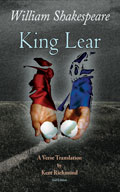
King Lear: A Verse Translation (more info)
ISBN: 0-9752743-2-5
ISBN-13: 978-0-9752743-2-3
Buy Paperback $9.95 Buy eBook $4.95
Macbeth: A Verse Translation (more info)
ISBN: 0-9752743-8-4
ISBN-13: 978-0-9752743-8-5
Much Ado About Nothing: A Verse Translation (more info)
ISBN: 0-9752743-3-3
ISBN-13: 978-0-9752743-3-0
Buy eBook $4.95
Romeo and Juliet: A Verse Translation (more info)
ISBN: 0-9752743-1-7
ISBN-13: 978-0-9752743-1-6
Buy Paperback $9.95 Buy eBook $4.95
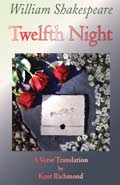
Twelfth Night: A Verse Translation (more info)
ISBN: 0-9752743-0-9
ISBN-13: 978-0-9752743-0-9
Buy Paperback $9.95 Buy eBook $4.95
Free U.S. shipping direct from publisher.
Other Interesting New Works
including a verse translation of Sir Gawain and the Green Knight
Excerpt from Macbeth
Act 2, Scene 2
Scene Two. Inside Macbeth’s Castle
[Enter LADY MACBETH]
LADY MACBETH
That which has made them drunk has made me bold.
What’s doused their flame has brought me fire.—What?—Nothing!
An owl just screeched, the bell for the condemned,
The harshest of good nights. He’s doing it.
The doors are open, and the stuffed attendants
Scoff at their job with snores. I’ve drugged their nightcaps,
So nature’s forces battle here to see
If they will live or die.
[MACBETH enters through the open door]
MACBETH
[from beyond the door] Who’s there?—What’s that?
LADY MACBETH
Oh, no! I am afraid they’ve woken up
And it’s not done. Attempt without the deed
Will wreck us.—Listen!—I laid out their daggers.
He couldn’t miss them.—Had he not resembled
My father as he slept, I would have done it.
My husband?
[Enter MACBETH, holding bloody daggers]
MACBETH
I’ve done the deed. Did you hear any noise?
LADY MACBETH
I heard the owl screech and the crickets cry.
You did not speak?
MACBETH
When?
LADY MACBETH
Now.
MACBETH
As I descended?
LADY MACBETH
Yes.
MACBETH
Wait!—The next room, who’s in it?
LADY MACBETH
Donalbain.
MACBETH
[Looking at his hands] This is a sorry sight.
LADY MACBETH
A foolish thought, to say a sorry sight.
MACBETH
First one laughed in his sleep, and one cried, “Murder!”
Enough to wake each other. I froze and listened,
But then they said their prayers and settled down
And fell asleep.
LADY MACBETH
The two share the same room.
MACBETH
One cried, “God bless us!” The other said, “Amen.”
As if they’d seen me with these hangman’s hands.
Hearing their fear, I could not say “Amen,”
When they had said, “God bless us.”
LADY MACBETH
Don’t think too deeply.
MACBETH
But why could I not say the word “Amen?”
I need his blessing most, and yet “Amen”
Stuck in my throat.
LADY MACBETH
We must not think about
These deeds this way, or it will drive us mad.
MACBETH
It seemed I heard a voice cry, “Sleep no more!
Macbeth has murdered sleep,”—yes, innocent sleep,
Sleep that rewinds unraveled threads of care,
The death of each day’s life, hard work’s warm bath,
Salve for hurt minds, and nature’s biggest course,
Chief nourishment in life’s feast.
LADY MACBETH
What do you mean?
MACBETH
Still it cried, “Sleep no more!” to all the house.
“Glamis has murdered sleep, and therefore Cawdor
Shall sleep no more. Macbeth shall sleep no more!”
What is a Verse Translation?
A verse translation maintains as closely as possible the rhythm and line length of the original work. Shakespeare's original lines from Twelfth Night and the ENJOY SHAKESPEARE verse translation are written in a kind of verse meter called iambic pentameter, or blank verse.*
Shakespeare’s Original Iambic Pentameter Lines
There is a fair behavior in thee, captain;
And though that nature with a beauteous wall
Doth oft close in pollution, yet of thee
I will believe though has a mind that suits
With this thy fair and outward character.
—Twelfth Night, Act 1, Scene 2
ENJOY SHAKESPEARE Verse Translation
I sense a decent man inside you, captain.
And although nature often hides what's foul
Behind a lovely wall, I can have faith
That you, sir, have a mind that matches well
This fair and outward character I see.
Prose translations, on the other hand, focus on capturing the literal meaning, without concern for the rhythm of the original. You will not sense a meter developing, and you will not feel like you are reading Shakespeare.
Prose Translation
You appear to be a decent person, captain, and although nature may hide inner corruption behind a beautiful exterior, I believe that you have a mind the matches your pleasant demeanor.
"Dumbed Down" Prose Translation
Viola said, “You seem to be a decent man, captain. Although awful people can seem nice, I believe that your pleasant behavior means you are nice inside too.”
* For more information on Shakespeare’s use of iambic pentameter, see “Appendix 1: How Iambic Pentameter Works” in Twelfth Night: A Verse Translation in English. Or for a brief description try this Wikipedia link. Here are two more extensive descriptions of Shakespeare's meter—"Scansion Guide" and "Teaching Meter" at the Interactive Shakespeare Project at the College of the Holy Cross Theater Department.
"Too often, unless we read a Shakespeare play beforehand, we process the language as if it were coming from a poorly tuned-in radio station. Shakespeare didn’t write his plays to be experienced impressionistically as ‘poetry;’ he assumed his language was readily comprehensible. At what point does a stage of a language become so different from the modern one as to make translation necessary? Mr. Richmond is brave enough to assert that, for Shakespeare, that time has come. The French have Moliere, the Russians have Chekhov—and now, we can truly say that we have our Shakespeare.”
—John McWhorter, Manhattan Institute
I wanted something more understandable. I found [Richmond's] script and loved it...The translation manages to maintain Shakespeare's brilliant form and rhythm."
—Shauna Huff, director of Romeo and Juliet: A Verse Translation,
Jonathan Alder High School
(Madison Messenger, 11/07/05)
[program cover art]


