Shakespeare Translations

 Julius Caesar: A Verse Translation
William Shakespeare
Kent Richmond (translator)
ISBN-13 9780983637905
168 pages
Full Measure Press

Julius Caesar: A Verse Translation
William Shakespeare
Kent Richmond (translator)
ISBN-13 9780983637905
190 pages
Full Measure Press


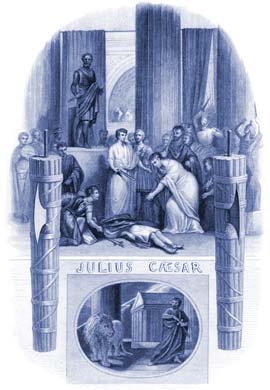
Brutus sees a ghost

This complete, line-by-line translation of Julius Caesar makes the language of Shakespeare's play contemporary while preserving the metrical rhythm, complexity, and poetic qualities of the original.
The aim is to capture both sound and sense of Shakespeare's tragedy without the need for glosses or notes—to use contemporary language without simplifying or modernizing the play in any other way.
Readers experience this tale of the brutal assassination of Rome's most famous leader and its aftermath with the challenge, comprehension, and delight of audiences 400 years ago—the way Shakespeare intended.
Excerpt from Julius Caesar: A Verse Translation
from Act 3, Scene 2
Mark Antony delivers a eulogy for Julius Caesar
MARK ANTONY
Read another excerpt
Distinguished Romans—
PLEBEIANS
Quiet, please! Let’s listen.
MARK ANTONY
Friends, Romans, countrymen, lend me your ears.
I come to bury Caesar, not to praise him.
The evil that men do lives after them;
The good is often buried with their bones.
So let it be with Caesar. The noble Brutus
Has said to you that Caesar was ambitious.
If it is so, then it’s a grievous crime,
And grievously has Caesar paid for it.
Here, by consent of Brutus and the rest,—
For Brutus is an honorable man,
As are they all, all honorable men—
I’ve come to speak at Caesar’s funeral.
He was my friend, faithful and just to me,
But Brutus says that Caesar was ambitious,
And Brutus is an honorable man.
He has brought many captives home to Rome,
Whose ransoms filled the public treasury.
Is this why he says Caesar was ambitious?
And when the poor have cried, Caesar has wept;
Ambition should be made of sterner stuff.
Yet Brutus says that Caesar was ambitious,
And Brutus is an honorable man.
You saw me at the feast of Lupercal
Present to him three times a kingly crown,
And three times he refused. Was this ambition?
Yet Brutus says that Caesar was ambitious,
And surely he’s an honorable man.
I’m not here to dispute what Brutus said,
But I am here to tell you what I know.
I know you loved him once—not without cause.
What cause prevents you now from mourning him?—
O judgment, you have fled toward brutish beasts,
And men have lost their reason! [weeps]—Bear with me.
My heart is in the coffin there with Caesar,
And I must pause till it comes back to me.
FIRST PLEBEIAN
There seems to be some sense in what he’s saying.
SECOND PLEBEIAN
If you consider carefully this matter,
Caesar’s been greatly wronged.
THIRD PLEBEIAN
He has indeed.
I fear that something worse will take his place.
FOURTH PLEBEIAN
Did you hear that? He would not take the crown.
That means it’s certain he was not ambitious.
FIRST PLEBEIAN
If we can prove it, someone must pay dearly.
SECOND PLEBEIAN
Poor soul! His eyes are red as fire from weeping.
THIRD PLEBEIAN
There’s not a nobler man in Rome than Antony.
FOURTH PLEBEIAN
Now listen. He’s about to speak again.
MARK ANTONY
Just yesterday the word of Caesar might
Have stood up to the world. Now he lies there,
The lowest now too high to show respect.
O masters, if I were inclined to stir
Your hearts and minds to mutiny and rage,
It might wrong Brutus and wrong Cassius,
Who, you all know, are honorable men.
I do not wish to wrong them and would choose
To wrong the dead, to wrong myself, and you,
Before I’d wrong such honorable men.
But here’s a document with Caesar’s seal—
I found it in his study—it’s his will.
If citizens could hear his testament—
Forgive me, but I don’t intend to read it—
Then they would go and kiss dead Caesar’s wounds,
And dip their kerchiefs in his sacred blood,
Yes, sneak a strand of hair for memory,
And, dying, mention it within their wills,
Bequeathing it as a rich legacy
Unto their offspring.
FOURTH PLEBEIAN
We want to hear it. Read it, Antony.
You must read us the will—Caesar’s will!
Read an excerpt from
Praise
"Too often, unless we read a Shakespeare play beforehand, we process the language as if it were coming from a poorly tuned-in radio station. Shakespeare didn’t write his plays to be experienced impressionistically as ‘poetry;’ he assumed his language was readily comprehensible. At what point does a stage of a language become so different from the modern one as to make translation necessary? Mr. Richmond is brave enough to assert that, for Shakespeare, that time has come. The French have Moliere, the Russians have Chekhov—and now, we can truly say that we have our Shakespeare.”
—John McWhorter, Manhattan Institute

Brutus